

Leaders who coach have a powerful advantage over those who don’t.
One of the hardest habits for any leader to break is the belief that they’re supposed to have the answers. After all, experience and expertise are often what got them into a leadership position in the first place.
But what happens when they don’t know the answer? Or, perhaps more importantly, when the person sitting opposite them is perfectly capable of finding a better-fitting answer for themselves?
Leaders who coach have the skills, tools and techniques to enable their people to figure things out for themselves and to keep learning from their own experience.
Prime amongst these skills is the ability to ask provocative questions (and to listen actively to the answers, but that’s a subject for another day).
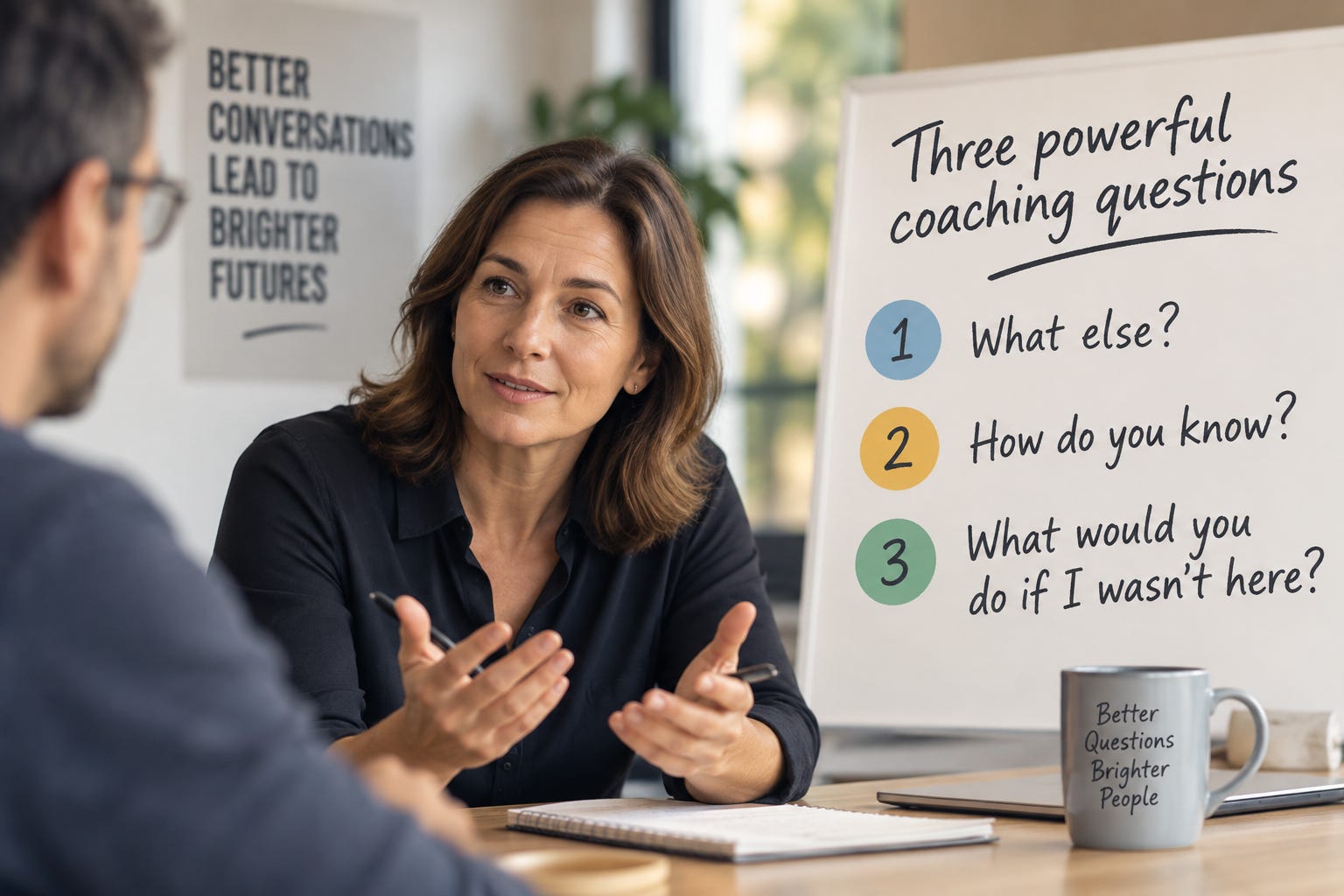
I want to outline three powerful coaching questions here that, whilst they’ll be very familiar to professional coaches, are less commonly used by leaders and managers who like to take a coaching approach. I have found them particularly useful down the years and well worth adding to your question bank after a bit of practice.
What else?
Experienced coaching-style leaders are adept at avoiding two common pitfalls:
Stopping at the first answer
Stopping at the ‘right’ answer
The first of these pitfalls is usually because the inexperienced coach is busy formulating their next question or wanting to make sure they follow the GROW model or whatever questioning sequence they’ve been taught.
The second happens when the leader has a strong sense of what the person they’re coaching ought to be doing, and they just keep going with their questions until, Bingo!, their coachee arrives at the ‘right’ answer as they see it.
Asking What else? guards against these pitfalls.
It encourages the coachee to go again, to think some more and to reconsider how thoroughly they’ve thought things through.
At the same time, it provides an opportunity for the coach to pause and think too.
I have found What else? useful throughout a coaching conversation at all stages. If we look at it through the lens of the GROW model, for example:
Goal
What else do you want?
What else could you try to achieve?
If you hit your goal early, what else could you move on to?
Reality
What else is happening?
What else do you notice?
Who else is involved?
Options
What else could you try?
What else do you think?
What else might others do?
Will
What else will/would you do?
If this takes too long, what else will you do?
If circumstances change, what else will you do?
Setting out coaching questions on paper like this always makes them look a bit artificial, but I’m sure you get the idea.
How do you know?
My years of practising the coaching approach have taught me time and again just how much people rely on assumption and presupposition.
They’ll say…
I can’t do that
It won’t work
Management won’t support that plan
I’m too old/young, over-qualified/under-qualified, senior/junior
…and so on.
None of these statements are necessarily facts, and I find the gentle rebuff of, “Well, how do you know?” very effective at teasing out just how little factual evidence people sometimes have for the assumptions they hold.
I coached a leader who wanted to improve his self-confidence. He had noticed that he had a tendency to mumble and stumble a little bit as he grappled to sometimes find precisely the right word for what he wanted to convey.
“People think I’m an idiot,” he told me gloomily.
“Really? How do you know that?” I asked in return.
It turned out that nobody had ever said anything, he’d never actually noticed any adverse reaction, and it had never been picked up by his peers or his bosses.
After we first discussed it, he went and sought some feedback on his concerns and people had no idea what he was talking about and couldn’t imagine why he was concerned.
In terms of the GROW sequence, this is about getting an accurate picture of the R for Reality. It’s about checking assumptions and exploring whether there is any evidence to back up or challenge people’s initial perspectives.
What would you do if I wasn’t here?
I love this one.
It gets right to the heart of the coaching principle of generating responsibility.
I like to define responsibility, in the coaching context, as:
A person’s choice to own a task and see it through.
It follows that a good coaching question will be one that encourages this kind of ownership and responsibility.
Unfortunately, our leadership style might inadvertently work against this. We may hold the belief that when our people come to us with problems, we’re supposed to supply them with the answers. Sometimes this may be true, an emergency being the prime example, but all too often when we do this we’re just reinforcing a sense of dependency.
It’s the equivalent of continuing to tie our children’s shoelaces for them instead of teaching them to do it for themselves.
Asking “What would you do if I wasn’t here?” is not an abdication of leadership responsibility; quite the reverse. Neither does it mean any loss of control for the leader because you’ll hear the answer to the question, which you can then accept or challenge as you see fit.
However, in my experience, what the individual was proposing in their own head is usually quite correct and the same thing I would do.
In fact, on many occasions, their answer would reveal something quite new, novel and probably better than what I might have suggested.
Once again, for the GROW aficionados, this is a question designed to generate more ideas at the O for Options stage.
The three questions outlined here may need rephrasing to sound a bit more like you, but I hope you can see the positive response they can generate.
And always remember that it is the answer that is most important, not the question, so if you need to give yourself a bit more time to think about what they’ve said, just ask…
…what else?
First published on TrainingZone https://trainingzone.co.uk/coaching-three-powerful-questions-to-challenge-your-learners/