

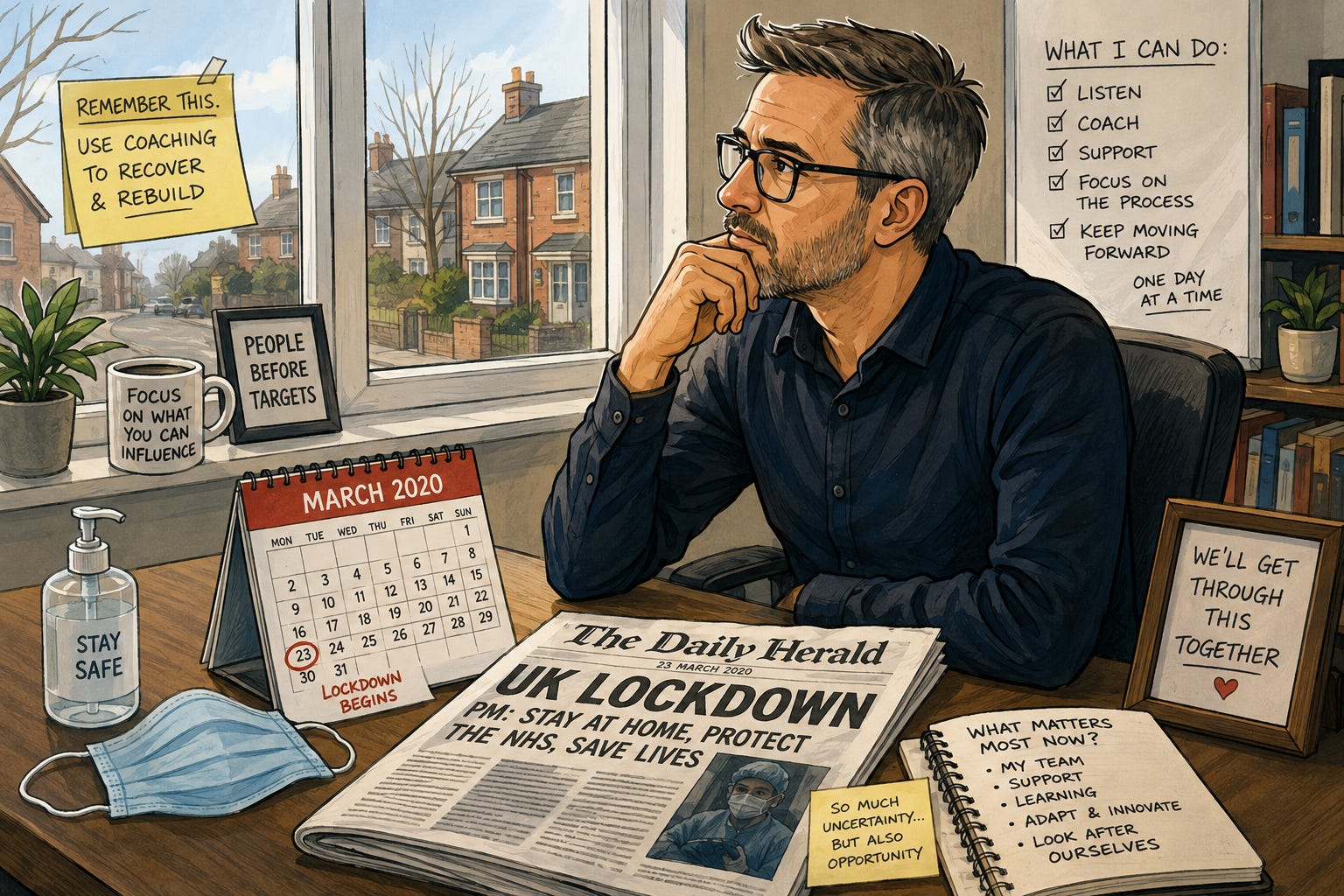
I wrote the original version of this article during Covid, when nobody was quite sure what the world of work would look like when we emerged from the other side.
Reading it again all these years later, some of the references have clearly aged. Zoom is no longer a novelty, we’re allowed back in the pub (even if only sitting down) and thankfully we’re not discussing what worked in February 2020 anymore.
But what struck me was how little the central argument has changed.
The uncertainty may now come from economic pressure, AI, war and conflict, restructuring or simply the relentless pace of change, but organisations are still asking people to adapt quickly, find new ways of working and, inevitably, do more with less.
So, with a little updating, I think my argument still stands: leaders who can coach their people are better placed to weather difficult times and emerge stronger when conditions improve.
Add coaching to your CV
Organisations will always need people skilled at achieving results through others.
This is even more the case in times of economic difficulty. Staffing levels may be cut, leaving managers and leaders needing to achieve the same results with fewer people. Those demonstrably able to do this are likely to be highly attractive and sought after.
If you’re able to include some specific results in your CV so much the better. “Coached my team and was able to cut wastage by 5% per annum” trumps “I am an effective manager of people”.
Coach your people if they’re frightened or uncertain
Put on your coaching hat and get talking to your team. Allow them to express their fears openly and tell them that you understand. After all, you’re probably in a similar position.
Remind them that now would be a really good time for the whole team to raise its game. That doesn’t have to be positioned as a threat, quite the reverse. The coaching approach will enable you to tap into their hidden talents, which were always there, but which maybe you didn’t need quite so much when circumstances were easier.
Coach the team to bring in more business
Unless your team are converting every sales lead already, there is unconverted business available to you right now. Why aren’t more leads being converted? What if every lead that wasn’t converted into a sale became a learning opportunity and a way to find out why not?
It may be that up till now your conversion ratios were enough to hit your targets and you could just resign yourself to the fact that you can’t win them all. That may not be enough when times are tougher. We need every lead to become either a sale or a lesson learned, and this is only possible from a group of people coached to perform, learn and enjoy in equal measure.
Protect your budgets by demonstrating value
There’s nothing like being able to show a return on investment to help protect the resources you need.
Any organisation that is continuing to operate will be spending money, it’s just that it will be more cautious about what it spends money on. It’s quite right that needless costs should be stripped out, but you need to help your senior team see your work as something that is crucial to long-term success.
This applies particularly to L&D. Demonstrating activity is not enough. We need to be able to show what changed as a result.
Use coaching alongside training
There’s likely to be pressure on training and development budgets when organisations are cutting costs, but a decline in formal training does not have to mean a decline in learning.
When you can coach, you are able to provide learning and development every single working day, irrespective of what formal L&D is able to provide.
What’s more, this type of learning is specific to the needs of the individual, requires no time away from the job and happens at exactly the time it is needed.
This doesn’t make training redundant. It makes coaching an important way of turning everyday work into everyday learning.
Keep them focused on the processes
At times of uncertainty the goalposts keep shifting. Business and working life in general can be unpredictable and you and your team have to become accustomed to working with ambiguity and sudden shifts in priorities.
This can be hard for people to cope with, but you can use coaching questions to allow people to vent their feelings and then return their focus to what needs doing today and tomorrow.
By focusing on processes we can continue to make progress even when the goalposts change.
Keep those options open
There is always a need for innovation and creative thinking when familiar approaches stop working or become unaffordable.
This is where coaching to generate truly imaginative options can help. There are two major barriers to overcome. Firstly, stopping at the first answer, where we allow the coachee simply to get on with the first thing they think of. Secondly, stopping at the right answer, in other words we keep coaching until the coachee says what we want to hear.
Again, who says that’s best?
Just keep asking, “What else?” and the creativity will eventually come.
Look after yourself
Since you’re reading this, I’m guessing you’re keen on developing skills that enable you to get the best out of others. Indeed, most of these suggestions have been about helping you to help your team cope with tough conditions.
However, don’t neglect yourself in all this. Try to eat, sleep and get some exercise and coach yourself to do so when you can.
Better yet, why not establish a co-coaching relationship with someone else who has learnt to coach, and support each other? I did this during the financial crisis back in 2010 and found it an enormous help.
Break with tradition
Our default setting tends to be to celebrate success and analyse failure. We go to the pub when we win a new contract and retreat to the boardroom for an in-depth post-mortem when a client is lost.
When successes become harder won and setbacks more frequent, this approach can become a bit demoralising.
From time to time, why not raise a glass when something’s gone wrong? You’ll have learnt from the experience and can celebrate the lesson learnt. Similarly, start to analyse your successes so that you learn to do more of the stuff that works.
Prepare for the upturn
Eventually, difficult periods pass.
When they do, breathe a sigh of relief and then look around and see a team that you’ve coached through the worst of times, now brilliantly placed to take advantage of the better times to come.
Whilst Bloggs Inc down the road battened down the hatches, cut everything it could and prayed, you engaged with your people and took them with you. You coached them and they’re up to speed with the market and the needs of your customers. They’re stronger for knowing that they can cope in trying circumstances and they’ve learnt what they need to do when conditions become difficult again.
Because if the years since Covid have taught us anything, it’s probably that another period of uncertainty will come along eventually.
Let’s just hope it’s not for a while.
Adapted from an article originally written during the Covid-19 pandemic.