

It was a bit of a rant, if I’m honest.
A potential client was showing me the course description for a two-day management training programme they liked the look of. There were a couple of hours on the second afternoon devoted to coaching, and the brochure claimed that delegates would leave with a handout of the GROW model and some example questions.
Not many people’s idea of a hill to die on, I admit. But the suggestion that this would be enough to equip a manager to coach effectively is, frankly, nonsense. And worse, it may be actively damaging.
Where the problem starts
I first started pondering this many years ago when someone told me they did something called “GROW coaching”.
I didn’t understand what that meant then, and I don’t really understand it now.
My concern was that it sounded like coaching-lite. Unfortunately, I’ve since seen that proven true more than once.
Now, a confession. I’ve been guilty of this too.
I’ve run training sessions where coaching got a cursory look and participants walked away with a few questions to try. But I won’t do that anymore. I’ve also run longer programmes where we take time to practise, reflect, observe reactions and learn how to respond in the moment.
There is simply no comparison.
Why this matters
Let’s be clear. I could hand anyone a list of questions organised around the GROW sequence. That does not make them a coach.
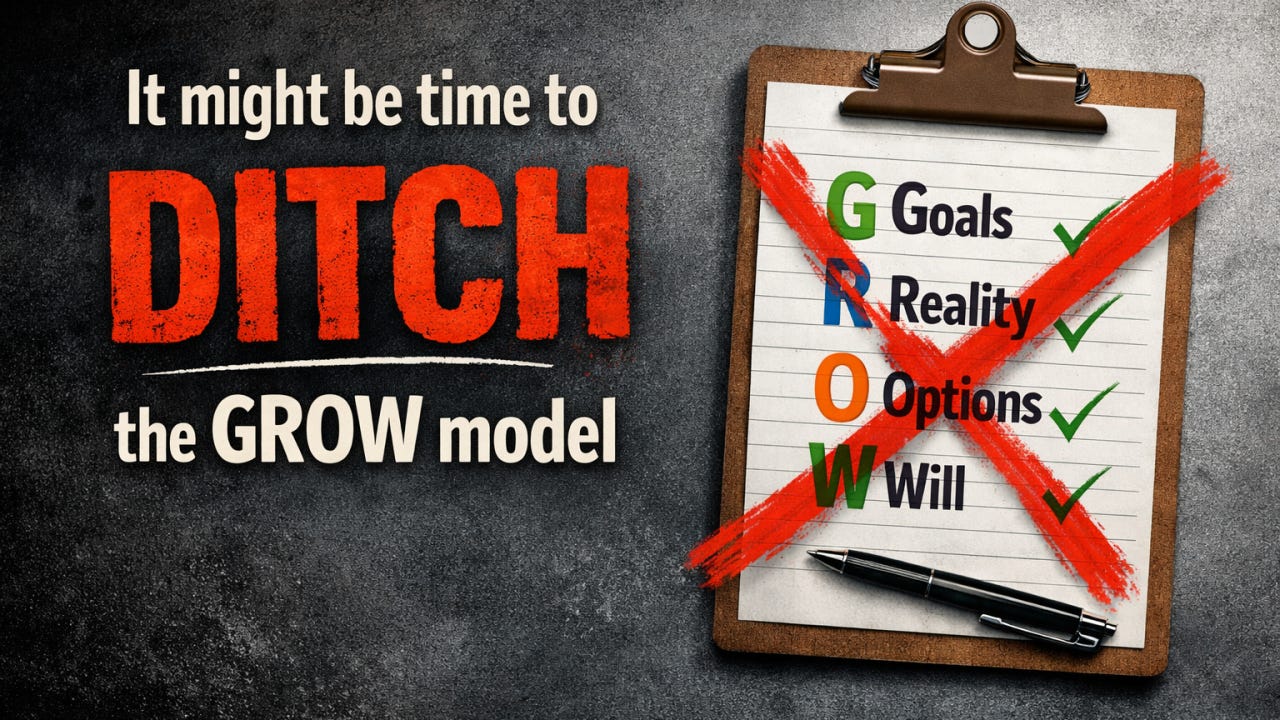
The GROW sequence is not a coaching model. It is a helpful way of navigating a conversation to ensure we explore four areas: Goals, Reality, Options and Will.
It is widely attributed to Sir John Whitmore, though it was likely developed alongside Graham Alexander and Max Landsberg.
The problem is not GROW itself. The problem is how it is used.
The danger of following the script
An over-reliance on GROW can make coaching feel rigid and mechanical.
A manager might confidently ask an “Options” question, only to find the coachee returning to their goals or noticing something new about their reality. Real conversations don’t follow neat sequences.
Coaching should not be forced into a linear structure. Good coaching moves around. It revisits, loops back and goes deeper when needed.
Even calling it the “GROW sequence” can be misleading. It suggests a tidy process that real human thinking rarely follows.
When the questions run out
A second issue is what happens after the question.
A handout might suggest asking, “How does this situation make you feel?” But it won’t tell you what to do when the answer is, “I’m terrified,” or “I’ve had enough,” or “I don’t care anymore.”
That’s where coaching either begins… or falls apart.
Without the ability to listen properly, interpret what’s being said, and respond in a thoughtful way, the conversation quickly becomes superficial.
Coaching is not just asking questions
A third problem is the belief that coaching is simply about asking questions.
It isn’t.
Coaching requires active listening. Real listening. Not glancing at a handout while waiting for your turn to speak.
It often involves noticing body language, tone and hesitation. It means being comfortable with silence.
In fact, those pauses are often where the most important thinking is happening. But they are easily missed if you are focused on asking the “next” GROW question.
But surely it’s better than nothing?
I’m not convinced it is.
If coaching conversations are too shallow, they don’t stick. Those beautifully crafted action plans created in the “Will” stage rarely survive first contact with reality.
Proper coaching anticipates this. It explores contingencies. It asks “what if?” It prepares people for the messy reality of execution.
A quick run through GROW rarely goes deep enough.
Worse, a poor experience of coaching can put people off altogether. It risks undermining efforts to build a genuine coaching culture.
The risk of getting it wrong
There is also a more serious concern.
Questions are powerful. Used carelessly, they can do harm.
I’ve seen coaching question lists that suggest asking, “What are you scared of?” That might sound insightful, but it can open up issues far beyond the scope of workplace coaching.
Without the skill to handle what comes back, we risk stepping into territory better suited to counselling.
As Sir John Whitmore once told me,
“Without an understanding of the underlying principles of awareness and responsibility, GROW or any of its variants is useless.”
So what should we focus on instead?
We need to shift the focus away from following GROW and towards understanding coaching principles.
I sometimes summarise this as coaching being an A.R.T.
Awareness
A good coaching question raises awareness.
“What’s happening?”
“What do you notice?”
“Who else is involved?”
The coachee must refer to their own experience to answer. In doing so, they become more conscious of what is really going on. Change often follows naturally from that.
Responsibility
A good coaching question reinforces responsibility.
“What have you tried?”
“What could you try next?”
“What will you do if that doesn’t work?”
The emphasis is on you. The coachee remains the decision-maker.
Trust
A good coaching question builds trust.
“What does your instinct tell you?”
“How have you handled something similar before?”
These questions communicate belief. They show that we trust the person’s judgement and capacity to learn.
What to do instead
If your coaching approach is built around GROW, try removing it for a while.
Get your managers to practise without the safety net. Let them focus on listening, responding and thinking in the moment. Do it in a safe environment before going live.
There is nothing wrong with having a bank of good questions. But context matters. Awareness, responsibility and trust should guide their use.
Because, in the end, any fool can ask a question.
It’s the shutting up and listening that takes real skill.
First published on TrainingZone https://trainingzone.co.uk/coaching-why-it-might-be-time-to-ditch-the-grow-model/