
If your managers have never been trained, start with coaching

“Most people here have had more training on using the fire extinguisher than on managing people.”
A newly appointed L&D manager said this to me recently and, sadly, it wasn’t difficult to believe.
A strategic review had highlighted a need to strengthen management capability if the business was to continue its almost uninterrupted growth. The directors weren’t surprised. Their managers were often reluctant to accept ownership and accountability and had a tendency to micro-manage.
My L&D client suspected this was because most of the managers had been promoted internally based on technical competence, with little or no management development along the way.
I’ve seen this pattern countless times.
What’s really going on?
Without any meaningful input on how to lead and get results through people, managers tend to fall back on experience.
They look backwards for role models.
They think about bosses they once worked for, or they scan the current workplace for clues about what “management” looks like there. Much of this happens unconsciously.
The trouble is, if those role models were poor managers themselves, then we simply reinforce bad habits and extend them into the next generation of leadership.
That was definitely happening in this business.
Because the managers were all long-serving internal appointments, no fresh thinking had entered the system. No external best practice. No challenge to the status quo.
The situation wasn’t going to improve by itself. In fact, it was likely to deteriorate.
The company had recently lost a major long-term contract and the strain had started exposing cracks in the culture. Blame was flying around quite freely. Trust was suffering. For the first time, resignation letters were beginning to appear in HR.
Ironically, the strategic review had also highlighted genuine strengths in the organisation’s culture and people. There was commitment, loyalty and hard work. The problem was that those qualities were no longer being channelled effectively.
So what can we do about it?
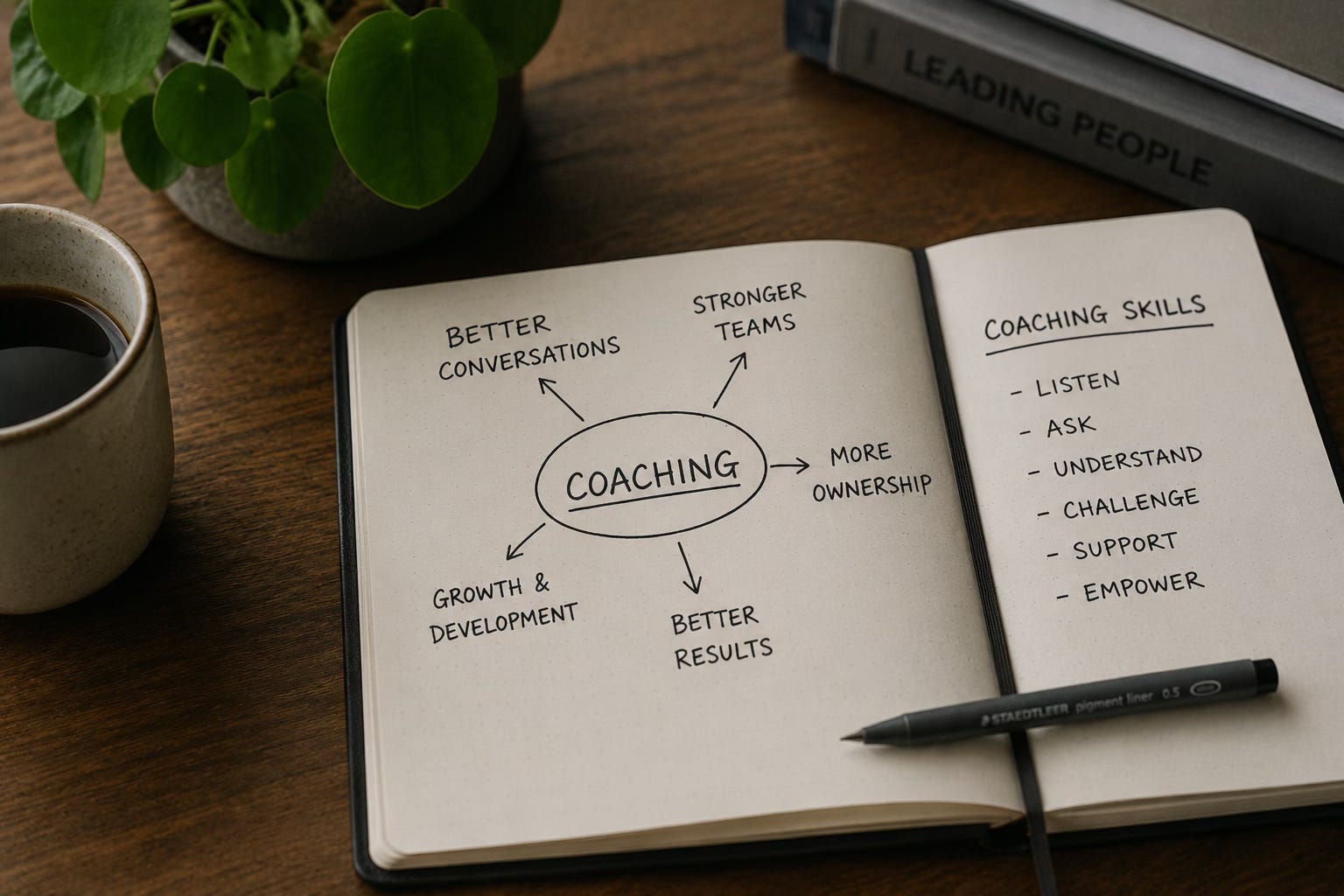
My recommendation, admittedly a slightly biased one, was that they start with coaching skills training for the managers.
But why begin with coaching when there had barely been any management development before?
I think there are three good reasons.
Extend the benefits
Firstly, coaching skills training affects people beyond those sitting in the room.
The real beneficiaries are the manager’s team.
Train one manager properly and you may positively influence six, eight or ten other people through the quality of the conversations that follow.
It’s a bit like the old party trick of pouring champagne into a tower of glasses. Fill the one at the top and the rest gradually benefit too.
That multiplier effect matters.
Particularly in organisations where budgets and time are tight.
Extend the budget
Secondly, coaching helps organisations use limited L&D budgets more intelligently.
Imagine there’s a widespread issue with time management.
One option is to send every employee on a time management course. Another is to train managers to coach people through their time management challenges as they arise.
The second approach is often:
cheaper
more contextual
more sustainable
and much more likely to stick
Because the learning happens in real time, around genuine work issues, rather than in abstract exercises removed from the workplace.
And importantly, it develops the manager too.
Extend the impact
Thirdly, coaching helps challenge the outdated idea that learning only happens on courses.
Too many organisations still separate “doing the work” from “learning about the work”, as though they are different activities competing for time.
A coaching culture starts to dissolve that distinction.
Development becomes something that happens continuously through conversations, reflection and problem-solving, not just when someone disappears into a training room for two days.
This was especially important for my client.
They worried that if they suddenly launched a raft of formal training programmes, there would be a huge release of pent-up demand they couldn’t possibly satisfy. That, in turn, might create even more frustration.
Coaching offered a more scalable and embedded approach.
Of course, coaching is not magic
Now, I should probably acknowledge something here.
None of this works automatically.
Training managers in coaching skills is not a silver bullet. Some managers will return enthusiastic but quickly fall back into old habits. Others may struggle with the shift away from telling and towards listening.
And yes, organisations still need other forms of development too.
My client would also have benefited from:
better performance conversations
clearer accountability
support around change and innovation
and stronger leadership alignment
But my strong feeling was, and still is, that all of those initiatives stand a far better chance of succeeding in ground already fertilised with a coaching approach.
Because coaching changes the quality of day-to-day conversations.
And culture is built conversation by conversation.
The management challenge has changed
There’s another reason this matters now.
Modern managers are increasingly leading:
hybrid teams
knowledge workers
fast-changing environments
people who expect development, not just direction
In that context, command-and-control management becomes less effective by the year.
Managers can no longer rely purely on expertise or authority. They need to help people think, adapt and grow.
Which is exactly what coaching helps them do.
Final thoughts
If your managers have never received much meaningful development, start now.
And if you’re wondering where to begin, start with coaching skills.
Not because coaching is trendy.
Not because every manager should suddenly become a textbook “coach”.
But because coaching changes the way managers relate to people. It encourages better listening, better questions and better ownership.
And in many organisations, those are precisely the skills that have been missing all along.
You may even find it helps put out the kinds of fires the extinguisher can’t touch.
First published on TrainingZone https://trainingzone.co.uk/if-youve-never-trained-before-start-with-coaching/