

I wrote this a while ago, but it still feels relevant now.
You may have seen Alister Shepherd’s excellent article on TrainingZone, Why Coaching is a Manager’s Job.
Given the time of year, you may even have resolved to be a manager who takes up the coaching challenge or, as an L&D practitioner, to help your managers accept that coaching is part of their role.
In this piece, I want to take that argument one step further.
I no longer think this is a matter of choice.
If you manage people, you’re already their coach, whether you like it or not.
Coaching qualities
On our coaching skills programmes, I often run a simple exercise.
I ask participants to list the qualities of an effective coach. They usually come up with a healthy list, but if they stall, I ask them to think about someone they’d really like to be coached by and describe what makes that person appealing.
Then I gather their ideas on a flipchart. The one shown here is pretty typical
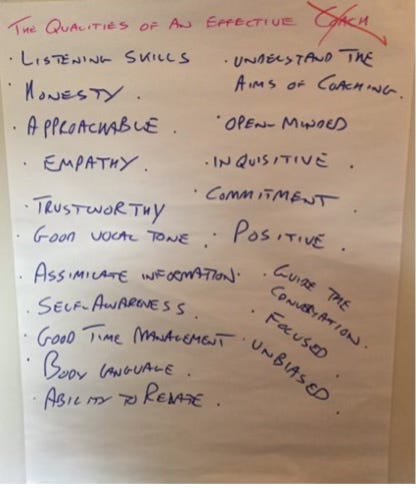
The results are remarkably consistent.
Listening is almost always first. Then we see qualities like empathy, trust, approachability and patience. Before long, someone usually points out that we’re really talking about emotional intelligence rather than technical expertise.
Then I ask a follow-up question:
“If I crossed out the word ‘coach’ and replaced it with your job title, what would come off the list?”
There’s usually a pause.
Then a bit of laughter. A few sighs. Someone mentions emails and meetings.
And then the penny drops.
Nothing comes off the list.
The qualities of an effective coach and the qualities of an effective people manager are, for all practical purposes, the same.
So why don’t managers see it that way?
If coaching and management overlap so heavily, why is there still resistance?
One answer might surprise you.
It’s not a lack of training.
In fact, sending managers straight onto coaching skills courses is often the least effective place to start.
Training can be useful, of course. But without a shift in mindset, it rarely sticks. People come back from a course with good intentions, apply the new behaviours briefly, and then revert to old habits the moment pressure builds.
If we want managers to embrace coaching, we have to start earlier.
We have to help them see that their current approach isn’t working as well as it could.
Raising awareness first
A more effective starting point is awareness.
Before asking managers to “be more coaching”, we need to help them understand the impact of how they currently lead.
That might come from 360 feedback, engagement surveys or performance data. In smaller organisations, it may come from honest conversations between HR and line managers.
Either way, the goal is the same: to create enough insight for change to feel necessary, not just desirable.
The case for coaching hasn’t gone away
Once that awareness is there, the arguments for coaching tend to land more strongly.
And they’re not new.
You and your team have to deal with constant change
There was a time when knowledge lasted.
People could build expertise early in their careers and spend years refining it. Managers could pass that expertise down, and their authority came partly from knowing more than their teams.
That world has gone.
Knowledge now moves too quickly. What we learn early in our careers can become outdated in under a year. Managers simply cannot keep pace with everything their teams need to know.
Which means the role has to shift from providing answers to enabling thinking.
Hierarchies are disappearing
Organisations have become leaner, flatter and more complex.
Traditional hierarchies have given way to matrix structures. People often report to multiple stakeholders and work across shifting priorities.
In that environment, command-and-control leadership becomes less effective.
Managers cannot rely on position or authority alone. They need to help people think, adapt and respond in real time.
That is, at its heart, a coaching capability.
People are the only real competitive advantage
Technology can be copied. Investment can be matched. People cannot.
Every organisation is, ultimately, a collection of individuals and teams. If performance is going to improve, it will come from improving how those people think, collaborate and act.
And yet, it’s remarkable how often we hear managers say, “We need to get the best out of our people,” while behaving in ways that do the opposite.
Too often, we try to put performance into people, rather than create the conditions for it to emerge.
Coaching helps reverse that.
Your people expect to be developed
The psychological contract has changed.
Few people now expect a job for life. Instead, they expect to grow, develop and build their employability.
They want experiences that stretch them. Conversations that challenge them. Managers who take an interest in their development.
In short, they expect something that looks very much like coaching.
So what’s the conclusion?
If you manage people, you are already influencing how they think, learn and perform.
You are already shaping their development, whether intentionally or not.
Which means you are already coaching.
The only real question then is, are you doing it well, or badly?
Final thought
We can continue to treat coaching as a specialist skill, something separate from “real” management.
Or we can recognise what’s been true all along.
Managing people is coaching.
And once we accept that, the conversation changes.
First published on TrainingZone : https://trainingzone.co.uk/coaching-if-you-manage-people-youre-a-coach-whether-you-like-it-or-not/