

I undertook some primary research into coaching in organisations some years back when I was studying for my MSc.
I was kindly invited by the L&D manager at a local contact centre to spend a day with them observing the coaching their team undertook with the operatives who manned their phones. He was clearly very proud of their coaching set-up and I suppose welcomed the chance to show it off.
I was paired with a coach and she introduced me to the call operative whose customer interactions we were going to share through the headsets. I noticed that the coach had a clipboard with a pre-printed sheet on which she began to scribble furiously as the call progressed.
At the end of the call, which had all been pretty straightforward as far as I could tell, we ‘paused’ the call-handling system to enter the feedback stage. This entailed the coach running through her list of notes and pointing out where the operative had deviated from the scripts and missed a number of cross-selling and upselling opportunities.
This is not coaching.
I’m not saying the content of this kind of exchange cannot ever be useful, but it certainly wasn’t in this case. It seemed to me that the more the coach spoke, the more deflated the operative became and that the more she tried to fill his head with more rules to follow, the less likely he’d be to act upon them.
Little, if any, learning had taken place. At best this was a kind of crude feedback, at worst it was a dismantling of self-confidence.
Now, there could be dozens of aspects of a coaching relationship that could explain this, but in this article I’d like to pick up on just one: the absence of coaching questions.
Coaching questions
Question: Why, normally, do we ask questions?
Answer: To get answers.
But coaches do not always get answers. In fact, sometimes the biggest indication that a coach’s question has given a coachee some fresh insight, and that they may be on the cusp of learning something vital, may be a wry smile, a shake of the head, a far-away look or complete silence.
So perhaps there is another reason for coaches to pose questions.
I believe that the efficacy of coaching questions lies in their power to promote thought.
Between stimulus and response, we humans have the capacity to think; a moment in which we can make a choice about how to respond in a certain situation. It follows that if we can increase the quality of thinking, we’ll increase the odds of a better end result or decision and consequently our performance.
Coaching, particularly asking questions, produces a higher than normal quality of thinking because it encourages the raising of non-judgemental awareness. As I become more aware of the variables in any situation and, just as importantly, my feelings about them, I begin to understand things better and see more options for change.
This concept can be found in many Eastern philosophies and is a central tenet of mindfulness. Put simply, before you try to change anything, increase your awareness of how it is now.
But the main point to clarify here is that coaches do not ask questions simply to get information; it is not a diagnosis. Instead, they ask questions so that the coachee has to think, and observe, before providing their response.
Ask, don’t tell
Asking questions encourages thinking and recognises that the people whom we coach have ideas and input and, more importantly, demonstrates that those ideas are welcomed and people’s input valued.
Telling or instructing does none of these things. It stifles creativity and innovation and encourages a culture of dependency on the leader, seeing them as the person with all the answers.
If you’ve ever found yourself saying (or thinking), ‘How many times must I tell you?’ or ‘If I’ve told you once, I’ve told you a thousand times!’ you’ll know this to be true.
Asking questions will mean that coachees achieve a much greater level of understanding about the work they do and the tasks they complete. You can ask questions in advance of the task to encourage the coachee to think about how they might go about things and the obstacles they might encounter, or you can ask questions after the task to find out what went well or badly, what was learnt and what could be done differently next time.
Of course, this will demand an investment of time from the coach, time that won’t always be available, but like any sound investment there will be a significant payback over time.
As the people you coach become more capable and confident because they’re thinking so well, they’ll become less reliant on you to solve problems and give direction.
Where the coachee’s work involves repetition, a coaching style that makes good use of thought-provoking questions can save hours of going over the same ground and repeating the same instructions.
Asking questions will promote a level of learning unavailable from the more controlling, tell-and-instruct type approach.
David Kolb’s learning cycle
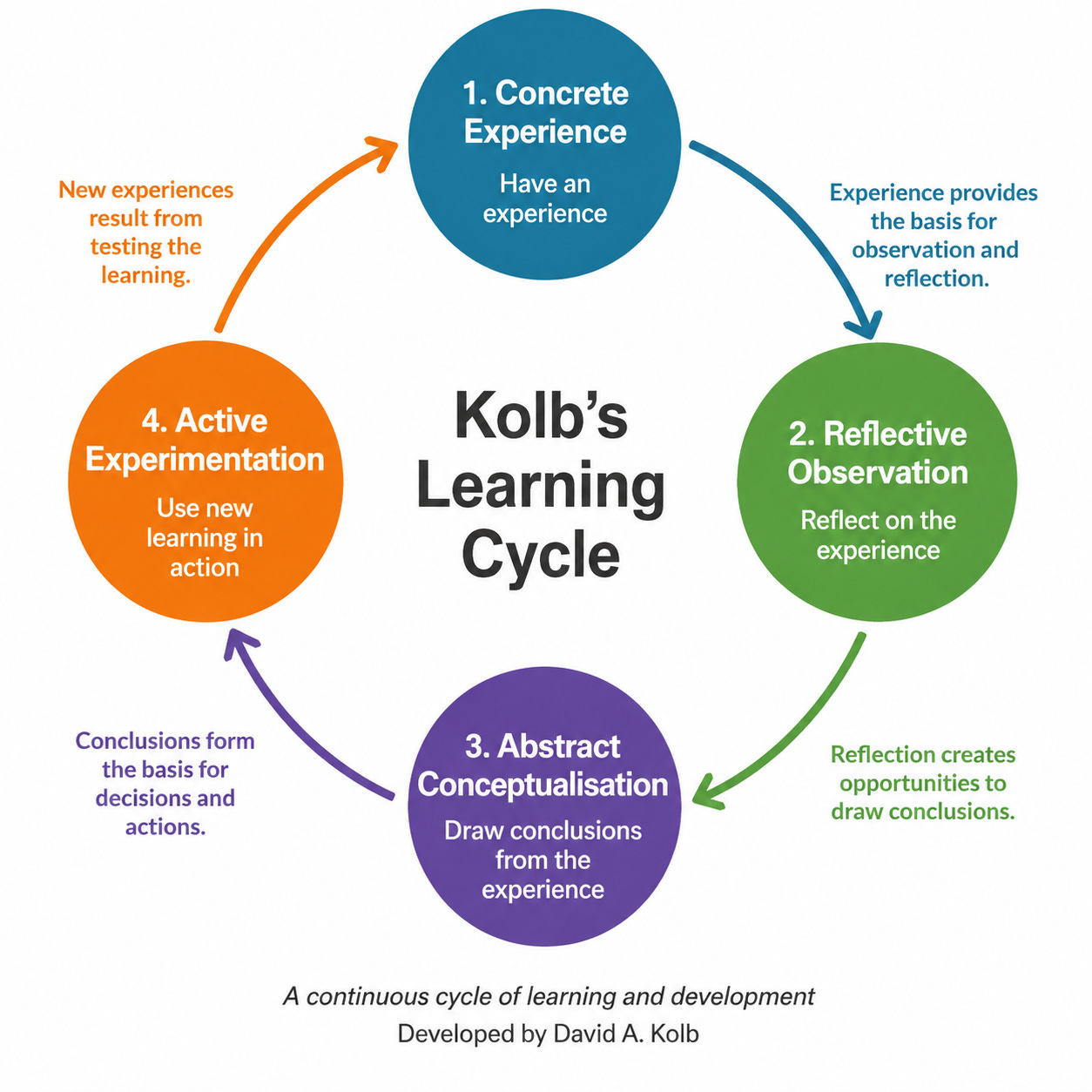
David Kolb’s experiential learning cycle (see image above) suggests that learning occurs as we have an experience, reflect upon it, draw conclusions from it and then use what we have learnt to inform what we do next.
In the frenetic world of work we mostly just plan and do, and sometimes the planning bit gets missed! A few judicious coaching questions will ensure we reflect and conclude without making more formal arrangements to do so.
All of this is going to lead to a much more involved and therefore motivated employee and, most importantly of all, will promote a much higher quality of task completion which can be measured and quantified in terms of money spent or time saved.
Back at the contact centre…
I might have debriefed the operative with questions like:
How closely were you able to stick to the script?
What caused you to deviate?
Which parts of that call were easier or harder?
What did you notice about the customer’s behaviour and communication?
Where were the main opportunities to discuss our other services?
I guess in the end it boils down to who needs to be thinking and learning from the experience.
If we want it to be our team members, those who coach need to get better at asking the right kind of questions.
If, however, we feel that what’s needed is not thinking but feedback, instruction, direction and compliance then fine.
But please, let’s stop calling that coaching.
First published on TrainingZone https://trainingzone.co.uk/ask-dont-tell-how-to-ask-effective-coaching-questions/