

A friend of mine found a new job in sales after a long time out of work.
He was both relieved and excited to land the opportunity because he felt he had exactly the right mix of skills and experience to be successful.
Although his most recent role had not had a direct selling element, he had years of sales experience and was looking forward to getting back into it.
But after a promising start, things began to take a turn for the worse. The company’s main product changed, making it much harder to sell and less relevant to the client database he’d inherited.
The company also changed the territorial boundaries and he found himself with far fewer of the affluent prospective clients he needed.
This started to become worrying and unsettling for my friend. After all, he was an experienced seller with a terrific track record, but his results were in freefall and his bosses were getting increasingly uptight.
He knew that I coached senior leaders on a one-to-one basis and asked if I’d be willing to help.
To begin with, I wanted to understand what would happen if things didn’t improve.
My friend said:
“Oh, they’ve told me in no uncertain terms that I’ll have to attend a disciplinary interview where we’ll examine ways my performance could improve, with a timetable and methods for tracking improvement.”
“And what did you say?” I asked.
“I said that sounds like it could be really helpful and could we do it now please!!”
That answer stuck with me.
According to Acas, a disciplinary procedure is a formal way for an employer to deal with an employee’s:
unacceptable or improper behaviour (misconduct)
performance (capability)
I can absolutely see the point of disciplinary procedures for misconduct.
Recurring lateness.
Questionable sickness absence.
Rudeness to customers or colleagues.
Those situations may require firmness.
But disciplining somebody regarding capability, struggling to deploy their knowledge, skills, experience and resources effectively, has always felt less convincing to me.
From a coaching point of view, I’d much rather see these issues tackled long before talk of disciplinary procedures. In doing so, perhaps we replace the terms misconduct and capability with something more optimistic:
Willingness and Ability
A question of willingness or ability
For example, how would you approach coaching these people?
John
John is something of an excited puppy.
He works with great enthusiasm but often gives clients incorrect information because he does not properly understand how fees are worked out.
Several clients have complained, which makes John quite upset and you’re concerned his motivation and enthusiasm may start to disappear.
Ringo
Ringo is a management graduate with a wide knowledge of business processes.
However, he is reluctant to delegate tasks and, when he does, worries constantly while other people do them.
Georgina
Georgina consistently uses inappropriate humour with customers and often comes across as sarcastic and disrespectful.
She was scheduled to attend a customer care seminar but did not show up.
Paul
Paul is suddenly and surprisingly becoming cynical and negative.
He was once the first to embrace any new initiative and still does, though not with quite the same enthusiasm.
He has completed company training and recently passed a college diploma course. However, he has recently told you he doesn’t feel his actions have any effect on how the department operates.
Four different responses
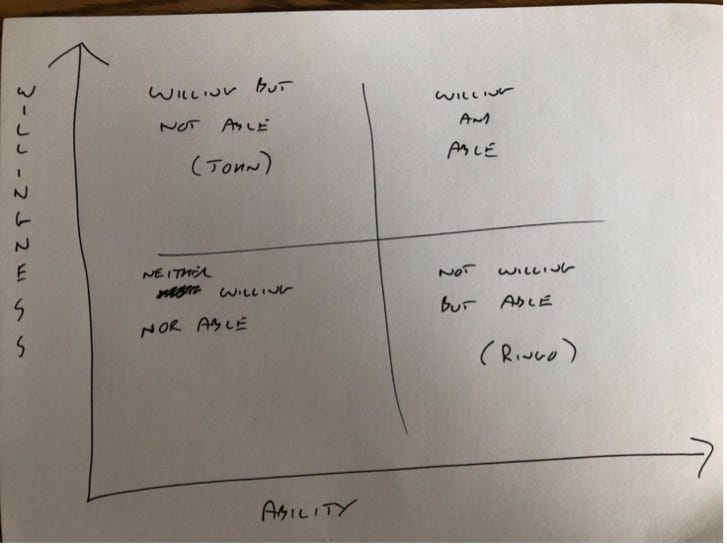
John is willing but not able.
He has the motivation but not yet the skills.
Here we could use coaching to harness that motivation and create an environment of trust where he feels comfortable asking questions and seeking explanations. You may also need to tolerate some early mistakes while capability catches up with enthusiasm.
Ringo is the opposite: able but not willing.
It’s not that he doesn’t know how to delegate. It’s that he doesn’t put it into practice.
He probably doesn’t need more training, that may simply frustrate him further. Instead, he may need coaching to understand his reluctance to let go, which is often rooted in fear of losing control.
Georgina appears to be neither willing nor able.
If you believe it’s worth investing further time and effort, I’d suggest starting with willingness. Coaching may help restore motivation but you’ll also need to monitor behaviour closely and provide clear feedback.
After that, the next move belongs to her.
Paul is willing and able, but he may not remain so unless we create opportunities for responsibility and influence.
He may need trust more than development.
We need to increase awareness by seeking his feedback and inviting his thoughts and suggestions.
The four combinations can be arranged on a graph, like the one above
Back to my friend
In fairness, he worked for a company that had grown very quickly and lacked a seasoned HR function and that may well have been part of the issue.
But his story highlights two coaching principles that I think remain important.
Telling somebody to do something does not make them able to do it.
And waving sticks, disciplinary interviews, threats and consequences, may work a treat in motivating donkeys but doesn’t do much for professional adults in a work situation.
Which reminds me of the old line from the company director who announced:
“Unless morale improves, sackings will continue.”
Funny because it’s ridiculous.
But perhaps slightly less funny because versions of it still exist.
First published on TrainingZone https://trainingzone.co.uk/performance-management-why-poor-results-should-be-managed-with-coaching-not/